
For independent IT equipment dealers, Managed Print Service (MPS) providers, and MSPs, balancing manufacturer relationships with actual contract profitability has always been a delicate tightrope act. On one side, meeting OEM volume quotas is essential for preserving tier standings, securing rebates, and maintaining official dealer authorization. On the other side, relying 100% on OEM consumables and parts across every single machine fleet can squeeze service contract margins to thin levels.
When you factor in escalating commercial warehouse rents, labor overhead for double-handling packages, and capital tied up in slow-moving inventory, traditional stocking models quietly erode profitability.
To remain competitive and protect cash flow, leading dealers are shifting away from rigid, stock-heavy operations toward a Hybrid Sourcing Framework backed by Virtual Warehousing. Here is how this operational shift works and why it protects both your bottom line and your OEM relationships.
1. The Hidden Tax on Dealership Capital
Holding extensive physical inventory locally used to be viewed as a service advantage. Today, carrying excess safety stock acts as an operational drag.
When you break down the true cost of carrying inventory, every box on a warehouse shelf incurs four hidden costs:
-
Capital Compression: Dollars tied up in slow-moving SKUs sit idle on shelves rather than funding sales expansion, technician recruitment, or marketing campaigns.
-
Real Estate Overhead: Commercial warehouse square footage costs continue to rise, consuming cash flow for space that produces zero direct revenue.
-
Double-Handling Friction: Receiving shipments, unboxing, re-labeling, and re-shipping parts creates unnecessary labor hours and increases shipping error rates.
-
OEM Quota Distortions: Buying bulk volume upfront purely to hit manufacturer rebate tiers often leads to inventory loading, artificially depressing operating margins.
Total Cost of Carrying Inventory = Storage Space + Capital Costs + Inventory Risk + Labor Overhead
Rethinking your supply chain doesn’t mean abandoning your core vendors—it means adopting a smarter, tiered approach to inventory management.
2. The Solution: The Hybrid Sourcing Framework
A hybrid sourcing strategy allows dealers to maintain full manufacturer compliance where it matters most, while recovering profit margins on mature or out-of-warranty hardware.
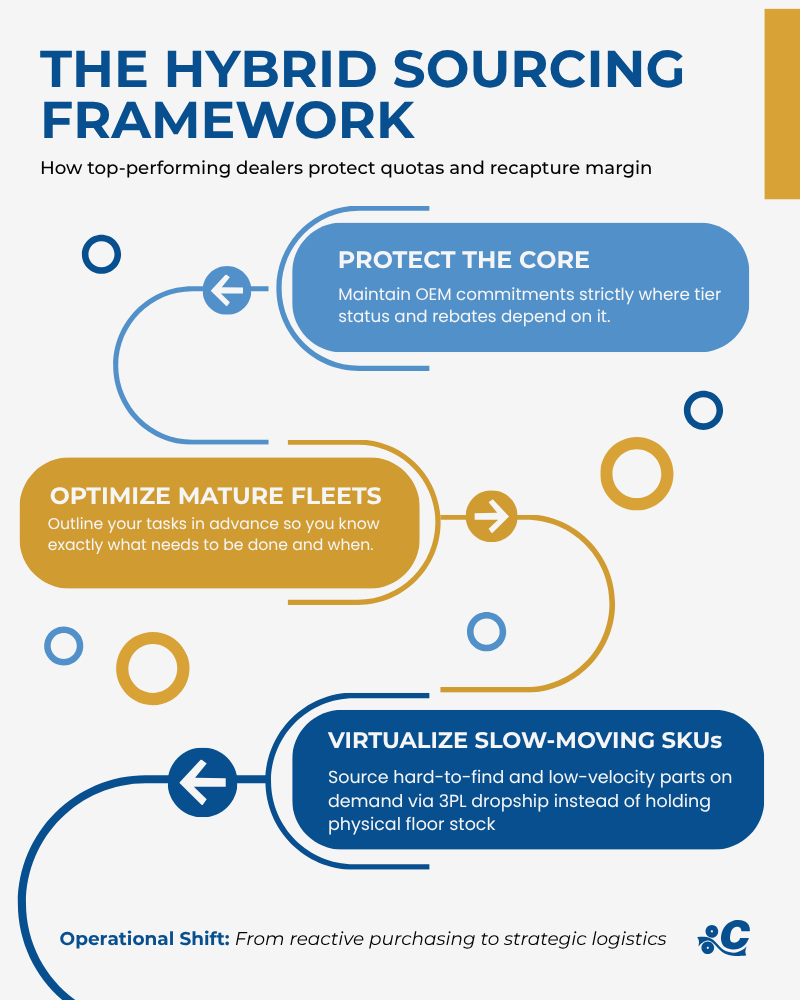
Pillar 1: Protect the Core
Keep primary hardware placements and core high-volume accounts aligned with OEM requirements to safeguard your quota thresholds and partner standing.
Pillar 2: Optimize Mature Fleets
Deploy high-grade, vetted aftermarket consumables across legacy, out-of-warranty, or mid-tier fleet devices. Shifting mature contracts to high-yield aftermarket supplies can recover 20% to 30% in service margins without compromising print performance or reliability.
Pillar 3: Virtualize Low-Velocity Inventory
Rather than stocking expensive, hard-to-find, or slow-moving single SKUs locally “just in case,” leverage virtual warehousing.
3. Scale Operations with Virtual Warehousing & 3PL
Virtual Warehousing shifts a dealership from local storage management to an on-demand, nationwide distribution model. By integrating with third-party logistics (3PL) partners, you maintain rapid delivery SLAs and total brand authority without paying for extra warehouse space.
| Traditional Stocking Model | Strategic Virtual Warehousing |
|
Capital tied up in physical inventory
|
Liquid working capital reinvested in growth
|
|
High fixed overhead (lease, staff, utilities)
|
Variable cost structure aligned with real demand
|
|
Limited SKU variety on-site
|
Access to vast nationwide inventory hubs
|
|
Double-shipping friction and freight costs
|
Direct dropshipping to end-users under your brand
|
By routing 30% to 50% of routine consumables and service parts directly through direct dropshipping, dealerships achieve:
-
Lower Facility Overhead: Downsize regional warehouse space or repurpose floor space for equipment staging and technician training.
-
Eliminated Freight Touchpoints: Direct-to-client shipping removes secondary carrier costs and double-handling labor.
-
Higher Field Productivity: Field service engineers spend less time picking up parts from local hubs and more time completing billable customer calls.
4. Growth Ecosystem: Supply Chain Meets Marketing Automation
Saving money on logistics is only half the equation—you also need a predictable engine for driving new revenue.
The most efficient dealerships link physical distribution networks directly with digital marketing infrastructure. By connecting logistics partners like Copylite with automated marketing engines like Evolved Office, dealers can:
-
Automate Client Lead Nurturing: Run automated campaigns targeting client bases with new services, supplies, and equipment upgrades.
-
Empower Self-Service E-Commerce: Provide client office managers and service techs with branded ordering portals for instant fulfillment.
-
Maximize Co-Marketing Funds (MDF): Convert vendor marketing funds into lead-generation campaigns without taking focus away from daily operations.
Take the Next Step: Audit Your Sourcing Strategy
Building a resilient dealership doesn’t require taking on more overhead—it requires building a leaner operational model.
To evaluate your current holding costs and margin recovery opportunities:
-
Calculate Your Inventory Holding Costs: Audit square footage costs, dead-stock SKUs, and double-handling freight expenses.
-
Segment Your Fleet: Identify mature machine contracts where high-grade aftermarket consumables can instantly restore 20%–30% in margin.
-
Explore Virtual Logistics: Partner with a consultative supplier offering integrated 3PL fulfillment and automated demand generation.
Interested in discovering how much cash flow your dealership can unlock? Schedule a 15-minute Strategic Cost Analysis with our team to review your inventory mix and optimize your bottom line.